
Journal
Categories
Shop Sixty3 Styled
Discuss Your Project
Beautiful spaces begin with a conversation. Share your ideas with us and we’ll shape an interior that feels effortless, personal and timeless. Every detail is approached with care, from the first concept to the final touch.
Let’s begin your design journey.
If WE were designing your kitchen tomorrow
The measurements that make or break any kitchen and how to design a kitchen that is both aesthetic and functional. Beyond the beautiful finishes and perfectly styled shelves, a kitchen has to function properly. When it doesn’t, not even the most beautiful marble slab can save it. Below is the framework I use when designing a bespoke kitchen. Practical first, aesthetic second, always in that order.
THE WORK TRIANGLE
The foundation of good kitchen planning is the work triangle. This invisible triangle connects the sink, the hob and the fridge. These are the three most used points in most kitchens.
The aim is to keep travel between them efficient, without cramping the space.
The two principals I follow to achieve this:
• Each leg of the triangle ideally between 105 cm and 250 cm
• No major obstacles cutting through the triangle
If the triangle is too tight, two people cannot work comfortably. If it is too spread out, you spend your time pacing.
In larger kitchens, particularly open plan spaces, the triangle often becomes more of a zone system. Prep zone near sink and the cooking zone near the hob. Cold storage slightly offset but accessible. However, the principle remains the same; to minimise unnecessary movement.
One of the conversations we have on every single project is hob or sink on the island. It is never a throwaway decision as it completely changes how the room feels and how it functions.
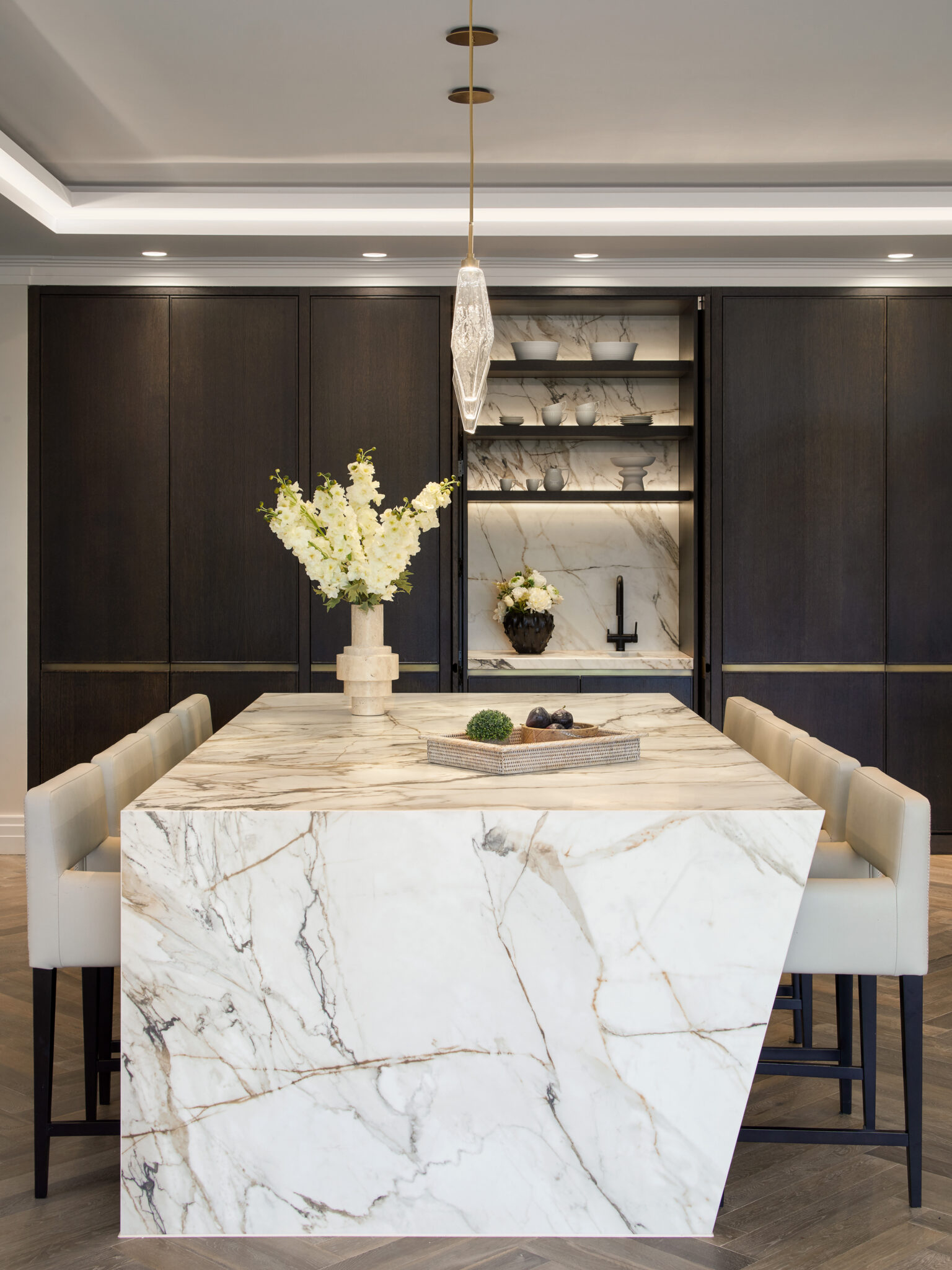
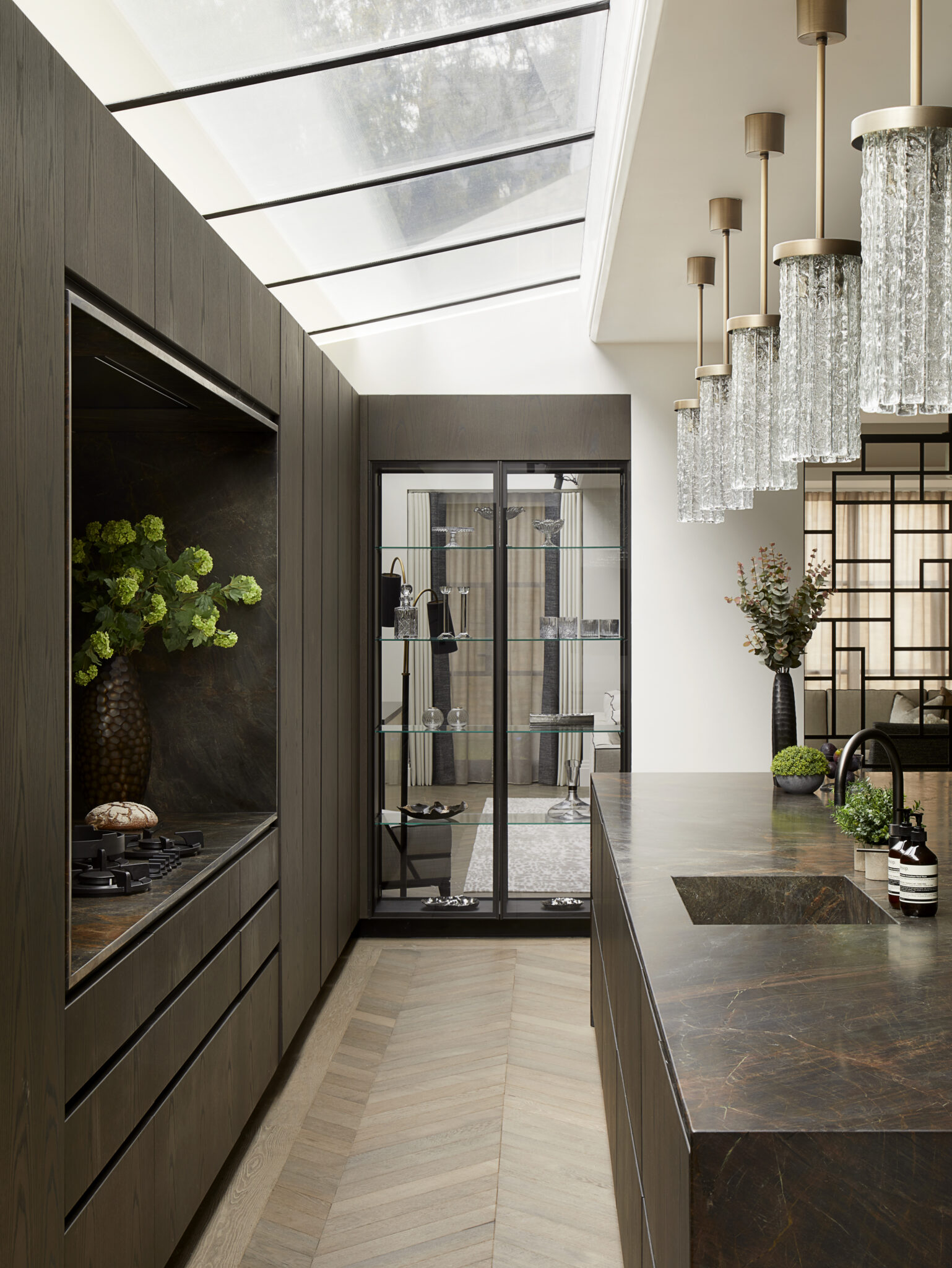
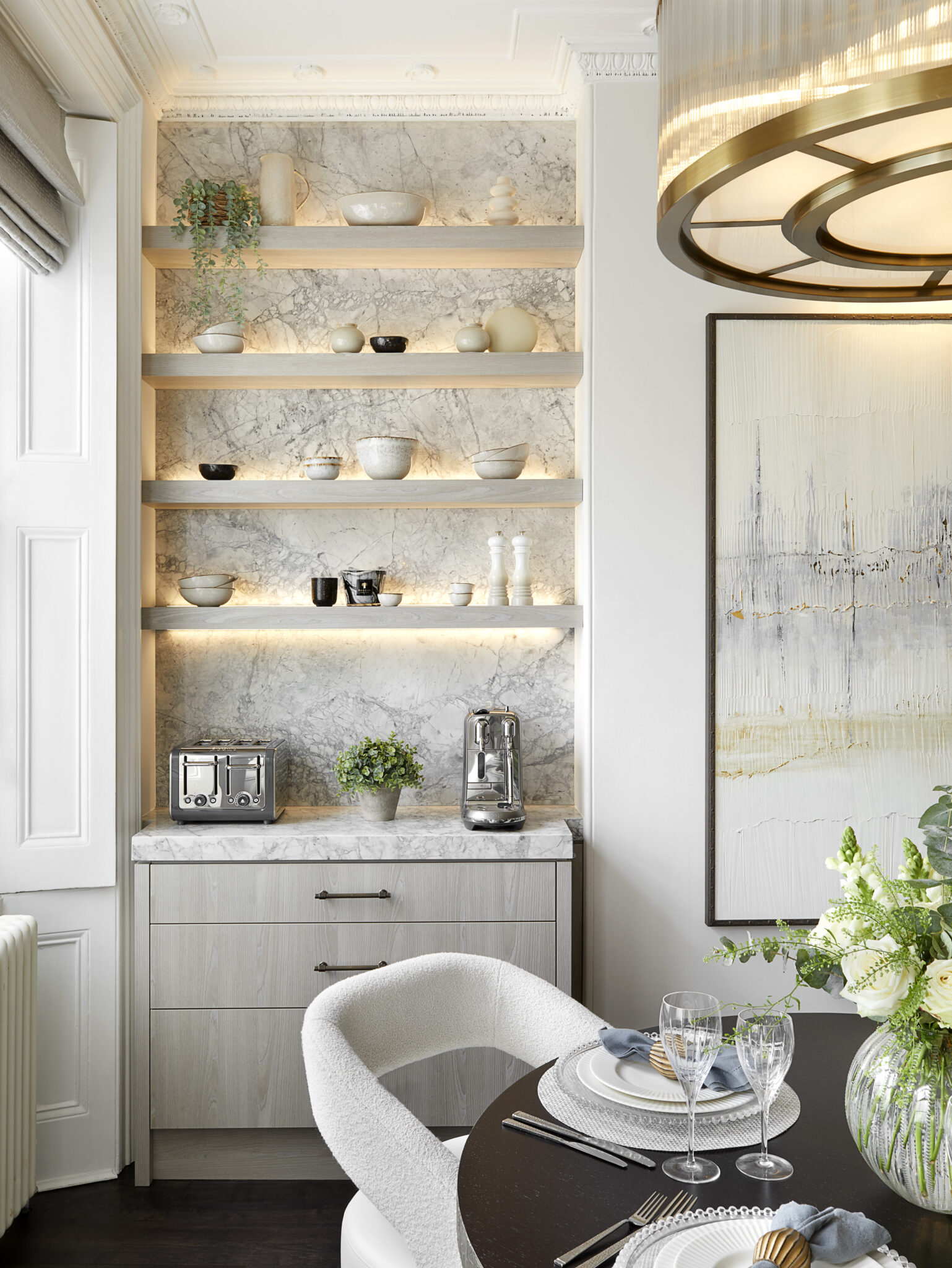
HOB ON THE ISLAND
The biggest advantage is sociability. You are facing the room while cooking. You can talk to guests, see the children, stay connected. In open plan homes this can feel important.
However, there are trade offs. A hob on the island means extraction becomes more complex. Ceiling extractors require sufficient ceiling height and proper ducting. Downdraft systems are improving but still need careful planning and storage sacrifice beneath. You also need to consider splatter and visual clutter. Pans, steam and cooking mess are suddenly centre stage.
SINK ON THE ISLAND
A sink on the island often makes more practical sense. Prep happens here, and you can still face the room while chopping and washing. The hob can then sit neatly on a back run with strong extraction and often better visual balance.
The downside is that sinks create mess. Dirty plates and glasses are more visible unless you are disciplined about loading the dishwasher quickly or have the luxury of a dirty kitchen.
HOB ON THE BACK WALL
Placing the hob on the back wall can create a strong focal point, especially framed with stone or a plaster hood. Extraction is simpler and often more powerful. But some clients dislike cooking with their back to the room. In those cases I sometimes adjust the layout so that the island is positioned in a way that still allows visual connection, or we introduce a secondary prep sink to keep the island active.
There is no universal answer. It depends on ceiling height, extraction routes, storage requirements, how the family actually cooks and how tidy they are. We talk it through every time because every client and project is different when it comes to finding teh right answer.
ON SYMMETRY
Kitchens often default to symmetry. Matching wall units. Perfectly centred hobs. Identical pendants. I get that it feels safe and orderly.
But complete symmetry can also feel static. In my opinion, a little asymmetry adds depth and interest. An off centre open shelf. A tall pantry run balanced by a lower cabinet or open shelves on one end of the island.
In bespoke design especially, I prefer controlled imbalance. Enough structure that the space feels calm, but enough variation that it feels considered rather than formulaic. Real homes are not showrooms. A touch of asymmetry can make a kitchen feel layered and quietly confident rather than overly staged.
Minimum Dimensions That Matter
These are the number I rarely compromise on.
Worktop height
Standard height 90 cm. For taller clients 92 to 95 cm can feel more comfortable. This should relate to the main cook’s height.
Worktop depth
Standard base units are usually 60 cm deep. I often increase to 65 cm where space allows for a more generous feel and better appliance housing. Many luxury kitchen appliances demand deeper and wider depths. I recently specified this fridge freezer from Subzero Wolf which is 1219 mm wide and 610 mm deep and this gaggenau hob which is 1007 mm wide by 605 cm deep so we decided to make the worktops deeper to 740 mm which allowed for plenty or space around the appliances and deeper drawers under teh hob which are useful for larger pots and pans.
Island depth
As an absolute minimum depth for kitchen islands I recommend 90 cm. If there are no space constraints then ideal depth is between 100 to 120 cm if you want proper prep space. If seating is involved, you need additional allowance for overhang.
Island overhang for bar stools
You’ll need a minimum of 25 to 30 cm leg space and in my experience, even with my on the shorter side legs, anything less feels a little awkward and knees will hit cabinetry.
Clear walkway
The minimum distance from surface to surface, for example, an island to the worktop opposite should be 90 cm. Again, an ideal distance with no space restraints is 100 to 120 cm, we would go for the wider dimension in high traffic areas where people may need to walk past one another.
Typical appliance widths:
• Single oven 60 cm
• Double Oven 74cm
• Standard fridge or freezer 60 cm
• American style fridge 90 cm
• Standard dishwasher 60 cm
• Slimline dishwasher 45 cm
• Standard hob 60 to 90 cm
These dimensions are standard across most UK manufacturers, but always verify the exact model specifications before final drawings. Even a few millimetres can disrupt cabinetry.
Why I Prefer Drawers Over Cupboards
Whene it comes to kitchen storage, I am firmly in the drawer camp.
Deep drawers are significantly more practical than cupboards with shelves. With a cupboard, you crouch, reach and pull everything out to find what you need. With drawers, the entire contents come to you.
Benefits of drawers
• Better visibility of contents
• Easier access for heavy items like pans
• More efficient use of internal space
• Cleaner internal organisation
Internally, I specify oak cutlery inserts, spice dividers and pan lid racks wherever budget allows. Organisation is not an afterthought. It is part of the architecture in the kitchens we design and every detail of the clients life is factored into the design.
What I Think About When Designing a Bespoke Kitchen
Flow
How do you enter the room. Where will you prep. Where will you cook. Where do shopping bags land. Is there a natural drop zone.
Light
Where does natural light come from. Is the sink placed under a window. Do we need task lighting under wall units or in the ceiling.
Storage hierarchy
Every kitchen needs a hierarchy. Everyday items at arm level. Heavy appliances lower. Occasional pieces higher up.
Extraction
Ceiling height, duct routes and whether recirculating extraction will be sufficient. It is always better where possible to extract to an outside wall.
Noise
Open plan kitchens need quieter appliances. Dishwasher decibel levels matter. So do extractor ratings.
Power
Sockets inside drawers for concealed charging. Hidden pop ups on islands clad in the same material as the worktop.
Material ageing
Choose high quality, natural materials where possible. Overtime, marble will etch, painted cabinetry may chip, timber will move. We always design with this in mind so that ageing feels intentional, not like damage.
Flooring choices
This is where aesthetic and practicality often clash. Aesthetically, I love natural timber flooring in kitchens. It feels warm, layered and timeless. Particularly in open plan homes where continuity from living space into kitchen creates a seamless and cohesive transition.
However, wood is softer. It can dent. It can mark with standing water or oil from foods over time if not maintained properly. Engineered boards with a good lacquer or hardwax oil perform better than solid planks in this setting.
Porcelain tiles are incredibly durable and easy to clean. They are resistant to water, staining and scratching. In busy family kitchens they are often the pragmatic choice.
The trade off is grout. Grout lines can discolour over time and require maintenance. Larger format tiles reduce grout lines and therefore upkeep but it is still a consideration.
Natural stone is beautiful but can be porous. It requires sealing and ongoing care. In the right home, it is always worth it. In others, it can become a laborious stress point.
Underfloor heating works exceptionally well with tile and stone. With timber, it can also work well but must be specified carefully to avoid movement.
The Balance
A kitchen should not just photograph well. It should feel intuitive to use at 7am when you are half awake and at 9pm when you are clearing up after a busy day and every moment in between.
The most successful kitchens are not necessarily the most extravagant. They are the ones where proportions are right, storage is considered and movement feels effortless.
If you are planning a renovation without a designer, start with the layout and dimensions. Get those right first. Finishes can always evolve. Function is much harder to retrofit.
@SIXTY3LONDON
[instagram-feed feed=1]

Ready to transform your space?
We’d love to hear from you. Whether it’s a full renovation or a design refresh, our team is here to help bring your vision to life. Let’s create something beautiful together.